 Liana Laskin
English 48B
"The Other Two" by Edith Wharton
February 19, 2009
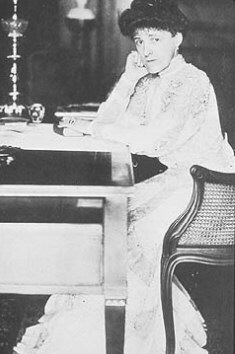
A "Rabid imperialist" (Wharton's description of herself, http://en.wikipedia.org/wiki/Edith_Wharton)
Summary:
Taking place in New York, Mr. Waythorn, a successful investor, is getting ready for his day. He and his new wife Alice (who is now married for the third time) are at home because Alice’s daughter Lily (whose father is Alice’s first husband, Mr. Haskett) is ill with typhoid. To see her father, Lily usually goes to his home once a week; since she cannot get out of bed, Haskett has insisted on coming to her. At first Waythorn is angry at his wife, but she soon calms him down and tries to please him by pretending as if their argument had never happened (this, in turn, makes Waythorn more uncomfortable because she has so easily moved on, like she was only acting). Waythorn leaves the house the next day (when Haskett will be in) and ends up running into Alice’s second husband, Mr. Varick, on the train. He informs Waythorn that his investing partner has been laid up with “the gout” and now Varick needs Waythorn to handle his accounts (Waythorn agrees to help his business). The conversation is awkward for Waythorn and he is relieved to get away. When he comes home, he questions Alice about Haskett’s visit; she simply says that she never spoke to him and he only had contact with the nurse (which turns out to be a lie). Waythorn ends up meeting Haskett, who is small and in a lower class than both Varick and Waythorn. Working with Varick and having Haskett over at the house visiting Lily makes it impossible for Waythorn to avoid either one of them. Eventually they all end up together in the study with Alice, which is awkward for all three of them as this has never happened before (even with this train wreck, things seem to end well for all involved).
Response:
I could argue both ways about whether or not Alice is being manipulative or not because sometimes she goes back and forth. When she gets into an argument with Mr. Waythorn, her third husband, and Mr. Haskett (her first husband) coming to see Lily, the daughter from Alice’s first marriage, she becomes vulnerable. Alice makes her lips quiver (as if she is about to cry) and makes Waythorn feel “like a brute” (832). She is also eager to please, letting all traces of the fight fade from her face as if she has already moved on from it. On the other hand, this behavior may be from marrying so many times. Wharton comments on how a little piece of Alice was lost every time she changed her name and who she was married to. I personally think that Alice really is not all that manipulative because she just does not come off as that kind of person to me. I found it highly amusing that all the character’s blushing was a nonverbal way of saying “Oh s**t,” especially because it would be extremely inappropriate to voice these reactions. Although the story did have a “happy” ending, I felt that having all three husbands in the room with Alice quite fitting because had the ending just been that Alice and Waythorn live as happily ever after as they could possibly be, it would not have the same satisfaction as what actually happened. I also do not see Waythorn as stupid, but in his own perfect little world where the fact that his wife had two other husbands does not have any effect on his marriage or life (his bubble just gets burst is all).

20 points. "I could argue both ways about whether or not Alice is being manipulative or not." Perhaps manipulation, like beauty, is in the eye of the beholder.
ReplyDelete